
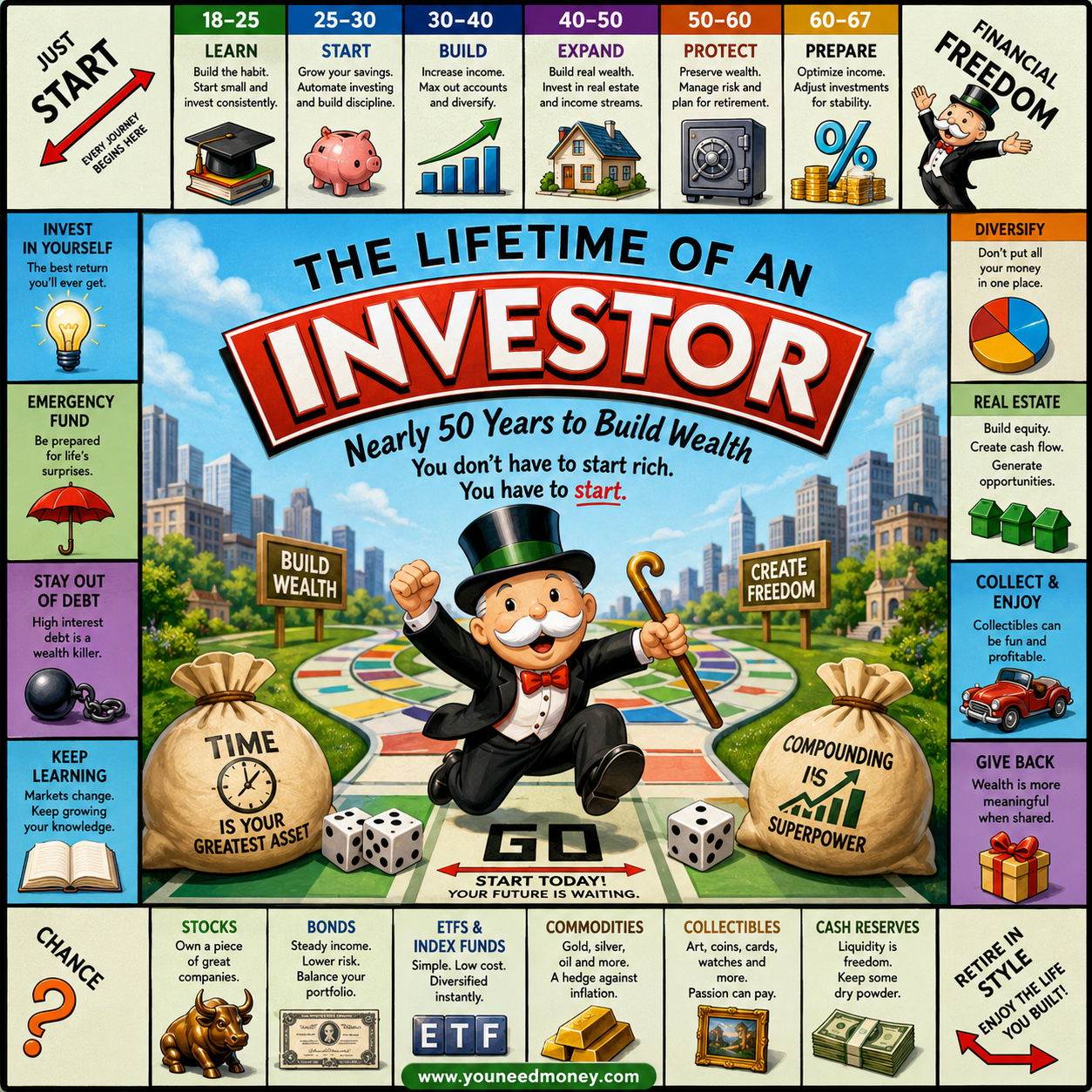
The 50-Year Investor: How a Lifetime of Small Decisions Can Build Wealth
Most people think about investing in terms of money: How much should I invest? What stock should I buy? Can I afford real estate?
Perhaps the more important question is:
How much time do I have?
For an 18-year-old entering adulthood, age 67 can seem impossibly far away. Yet that distance represents nearly half a century of potential investing.
And you don’t need to begin with $10,000.
You can begin with $25.
The SEC’s Investor.gov emphasizes that starting early makes compounding more powerful. It gives an example in which someone beginning at age 18 would need to invest about $127 per month to potentially reach $500,000 by age 65, assuming a hypothetical 7% average annual return. Someone waiting until 45 would need about $1,016 per month under the same assumptions. These are illustrations, not guaranteed returns, but they demonstrate just how valuable time can be.
Your 20s: Invest in the Habit
At 20, your greatest investment asset probably isn’t your bank balance.
It’s time.
Someone earning an entry-level salary may not have enough money for investment properties or a large stock portfolio. That’s fine.
Start small.
A young investor might begin with a workplace retirement account, IRA, diversified ETF or mutual fund, or simply a small recurring investment every payday. Before investing aggressively, establishing emergency savings and addressing expensive high-interest debt also deserves attention. Investor.gov specifically recommends starting early, identifying financial goals, addressing high-interest debt and taking advantage of an employer’s 401(k) match where available.
At this stage, the amount matters less than establishing the investing habit.
Twenty dollars becomes $50.
$50 becomes $100.
A promotion might turn $100 into $250.
The habit grows alongside your career.
Your 30s: Build the Machine
Your 30s can bring bigger salaries—but usually bigger expenses as well.
Mortgages, children, cars and other responsibilities compete for your paycheck.
This is when investing should begin moving from something you occasionally do to part of your financial infrastructure.
Retirement accounts can become larger. A taxable brokerage account may enter the picture. Homeownership can begin building equity. Some people might purchase a rental property or invest indirectly in real estate.
The important word here is diversification.
Rather than betting your future on one company, property or investment idea, diversification spreads your money among different investments. Your appropriate allocation depends partly upon your time horizon and tolerance for risk.
Your 40s: The Accumulation Years
By your 40s, something interesting may have happened.
You have accumulated not just money, but knowledge.
You’ve probably lived through recessions, bull markets, market corrections, housing booms and scary headlines.
Your income may also be approaching its strongest years.
That combination can make your 40s powerful accumulation years.
This could be the period for increasing retirement contributions, paying down a mortgage, building a larger diversified stock portfolio, acquiring investment real estate or developing additional income-producing assets.
It can also be a time when alternative investments become interesting.
Classic cars. Art. Watches. Coins. Sports memorabilia. Antiques.
Collectibles can certainly appreciate, but they should generally be viewed differently from a diversified retirement portfolio. They can be difficult to value and sell, generate no dividends or interest while you own them, and incur storage, insurance, maintenance and transaction costs.
A collectible can be an investment.
It can also simply be an expensive object you enjoy owning.
Knowing the difference is important.
Your 50s: Protect What You Built
At 25, a market decline can be frightening—but retirement might still be 40 years away.
At 58, the equation is different.
Your investment horizon is becoming shorter.
Investor.gov notes that investors with longer horizons may be comfortable with more volatile investments, while people with shorter horizons may prefer less volatile assets.
That doesn’t necessarily mean abandoning stocks.
It means asking different questions.
Instead of only asking “How much can this grow?”, you increasingly ask “How much can I afford to lose?”
This is a natural period to review diversification, debt, retirement projections, insurance, cash reserves and the balance between stocks, bonds, cash, real estate and other assets.
Your 60s: Turn Wealth Into Freedom
Eventually investing changes purpose.
At 25, the objective was accumulation.
At 65, the objective may become income, preservation and independence.
You may have retirement accounts, Social Security, a pension, home equity, stocks, bonds, cash, real estate or even valuable collectibles accumulated over several decades.
Now the challenge is coordinating them.
Social Security retirement benefits can currently begin as early as 62, although claiming before full retirement age reduces the monthly benefit. For people born in 1960 or later, full retirement age is 67, while delaying beyond that can increase benefits until age 70.
And retirement doesn’t necessarily mean you stop investing.
You may spend another 20 or 30 years as an investor.
The objective simply changes again.
The 50-Year Investing Timeline

An illustrative journey from learning and accumulation toward preservation and retirement income.
For the actual blog graphic, I’d make it more like a horizontal illustrated timeline:
AGE 18 → 25 → 30 → 40 → 50 → 60 → 67+
LEARN → START → BUILD → EXPAND → PROTECT → PREPARE → ENJOY & MANAGE
Underneath, we could show representative assets:
$25 investments → Stocks/ETFs → 401(k)/IRA → Home/Real Estate → Collectibles/Alternative Assets → Bonds/Cash/Income Assets → Retirement Portfolio
The central visual message would be:
Nearly 50 Years to Build Wealth
You don’t have to start rich. You have to start.
That’s potentially a very good signature graphic for the article because someone should be able to understand the entire premise in about five seconds.
Investor.gov lists stocks, bonds, mutual funds and ETFs among common investment categories and notes that real estate, precious metals, commodities and private equity can also form part of some portfolios, each with its own risks.
The Investment Most People Underestimate
The lesson isn’t that everyone should buy stocks at 18, a house at 30 and bonds at 60.
Real life doesn’t follow a perfect timeline.
Someone may start investing at 19.
Someone else may start at 39.
Another person might build wealth through a business, real estate or an unusual collection rather than primarily through the stock market.
The larger lesson is that time itself is an asset.
If you have $100, you have $100.
But if you have $100 and 40 years, you have something considerably more powerful.
Your twenties give you time.
Your thirties give you momentum.
Your forties can give you earning power.
Your fifties give you perspective.
And your sixties can give you something all those decades were intended to produce:
choices.
That may ultimately be the best definition of wealth—not simply having a large number on a statement, but reaching a point where your money gives you greater control over what you do with your time.
** This article is for general educational purposes and is not personalized financial, tax or investment advice. Investments can lose value.