
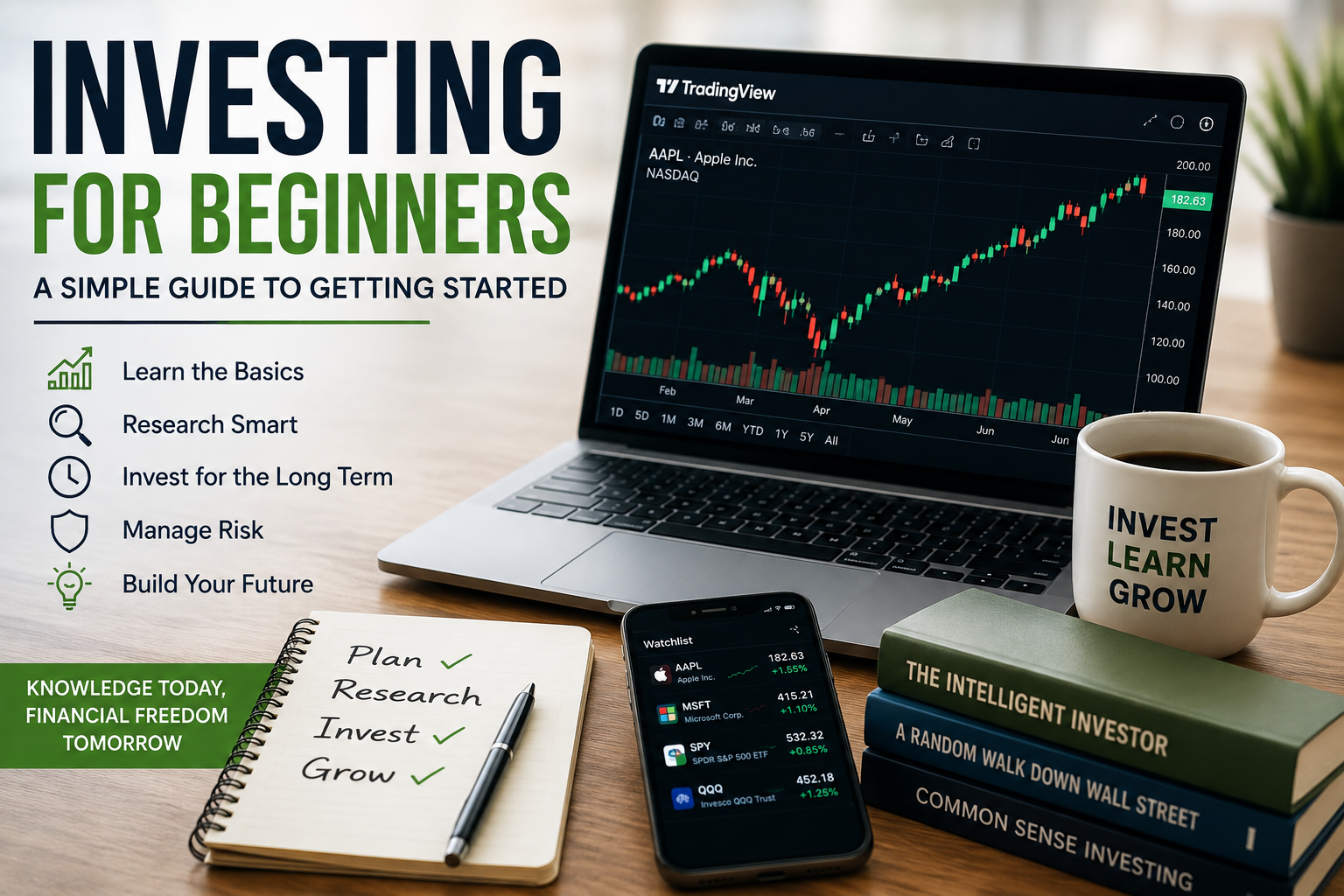
Investing for Beginners: How to Start Investing and Research Stocks
Investing for Beginners: A Simple Guide to Getting Started
Investing can seem complicated when you’re just getting started. Stocks, ETFs, dividends, charts, market indexes and countless financial terms can make it difficult to know where to begin.
But investing doesn’t have to start with picking the next hot stock.
A better place to start is understanding what you’re investing in, why you’re investing and how much risk you’re comfortable taking.
What Is Investing?
At its simplest, investing means putting money into an asset with the expectation that it may increase in value or generate income over time.
Some of the most common investments include:
- Stocks — ownership in individual companies.
- ETFs — funds that can hold dozens, hundreds or even thousands of investments.
- Bonds — essentially loans made to governments or companies in exchange for interest.
- Mutual funds — professionally managed collections of investments.
- Real estate — property purchased for income, appreciation or both.
Every investment carries some degree of risk. Prices can rise and fall, companies can struggle, and even broadly diversified portfolios can experience periods of significant losses.
That’s why learning comes before investing.
Investing vs. Trading
You’ll often hear the words investing and trading used interchangeably, but they aren’t necessarily the same thing.
An investor will often buy an asset with a longer time horizon, potentially holding it for years or decades.
A trader generally pays more attention to shorter-term price movements and may buy and sell much more frequently.
Neither approach eliminates risk, and neither guarantees profits.
For someone completely new to the markets, understanding long-term investing and diversification can provide a useful foundation before exploring more complicated trading strategies.
Start With Research, Not Predictions
One of the biggest mistakes a beginner can make is buying something simply because someone online says its price is about to go up.
Instead, learn how to research an investment yourself.
For an individual company, that might mean looking at its business model, revenue, earnings, debt, cash flow, valuation and competitors.
You can then look at the stock’s historical price chart to understand how the market has valued the company over time.
A chart can’t tell you what will happen tomorrow, but it can help you understand what has already happened.
A Useful Tool for Learning About Markets
One resource I recommend exploring is TradingView.
TradingView provides interactive financial charts along with tools for researching stocks, ETFs and other financial markets. You can create watchlists, compare investments, use stock screeners and study historical price movements.
Explore TradingView here:
https://www.tradingview.com/?aff_id=170227
For beginners, you don’t need to understand every indicator on the screen.
Start simple.
Look up a company you already know. Examine its chart over one month, one year, five years and longer periods. Then investigate the company’s financial information.
Do the same thing with a broad-market ETF.
The objective isn’t to immediately decide what to buy. It’s to become comfortable researching investments and understanding how markets behave.
What Is a Stock Chart?
A stock chart is simply a visual representation of a security’s price over time.
For example, you could examine what happened to a company’s stock price during:
- the last five trading days;
- the previous six months;
- the last year;
- the previous five years; or
- several decades.
Charts can also display information such as trading volume and various technical indicators.
It’s tempting to look at a chart that has risen dramatically and assume it will continue rising. That’s an important trap for beginners to recognize.
Past performance does not guarantee future results.
Charts are research tools—not crystal balls.
Don’t Overlook ETFs
You don’t necessarily have to identify individual winning companies to participate in the stock market.
Exchange-traded funds, commonly known as ETFs, allow investors to purchase an investment containing a collection of securities.
Some ETFs track broad market indexes, while others concentrate on particular industries, countries, investment styles or asset classes.
This can make ETFs an interesting subject for beginners learning about diversification.
However, an ETF isn’t automatically low risk simply because it’s an ETF. Always investigate what the fund actually owns, its costs and the risks involved.
The Power of Time
One of the most important concepts in long-term investing is compounding.
Imagine that an investment earns returns and those returns remain invested. Future returns can then potentially be earned on both the original investment and previous gains.
Over sufficiently long periods, compounding can become extremely powerful.
The catch is that actual investment returns aren’t predictable. Markets don’t move upward in a straight line, and periods of negative returns are inevitable.
This is one reason a long-term perspective can be so important.
Never Invest Money You Can’t Afford to Lose
Before investing, consider your overall financial position.
Money needed for your mortgage or rent, food, utilities, emergency expenses and other near-term obligations generally shouldn’t depend on tomorrow’s stock-market performance.
It’s also important to understand your own tolerance for losses.
Seeing an investment fall 10%, 20% or more feels very different when it’s your actual money.
Risk management is every bit as important as potential returns.
Beware of “Guaranteed” Investments
Be particularly cautious whenever someone promises guaranteed profits, unusually high returns with little risk, secret trading systems or opportunities that supposedly must be acted upon immediately.
Legitimate investing involves risk.
If you don’t understand how an investment works, there’s nothing wrong with walking away until you’ve researched it properly.
Sometimes the smartest investment decision is simply not making a decision yet.
Your First Investing Exercise
Before putting real money into the market, try building a hypothetical portfolio.
Choose several companies or ETFs that interest you and add them to a watchlist. Record their prices and follow them for several months.
Research why prices move.
Read company earnings reports. Follow major economic news. Learn what happens when interest rates change. Compare individual stocks against broader market indexes.
You can use TradingView to create charts and watchlists and begin researching different markets here:
https://www.tradingview.com/?aff_id=170227
There’s no requirement to buy anything. The first investment you make can simply be your time.
Final Thoughts
Successful investing isn’t about knowing what the market will do tomorrow.
Nobody does.
It’s about continually learning, understanding risk, researching opportunities and making decisions appropriate for your own financial situation and objectives.
Start slowly. Learn the terminology. Understand diversification. Study companies and funds. Become comfortable reading financial information and charts.
There’s an enormous amount to learn, but you don’t have to learn everything at once.
That’s exactly what we’re going to explore in upcoming articles: one financial concept at a time.
Affiliate Disclosure: This article contains an affiliate link to TradingView. If you sign up or purchase an eligible subscription through this link, we may receive compensation at no additional cost to you. This does not affect our editorial opinions.
Disclaimer: This article is provided for general educational and informational purposes only and should not be considered personalized financial, investment, tax or legal advice. Investing involves risk, including the possible loss of principal. Consider your individual circumstances and, when appropriate, consult a qualified financial professional before making investment decisions.